

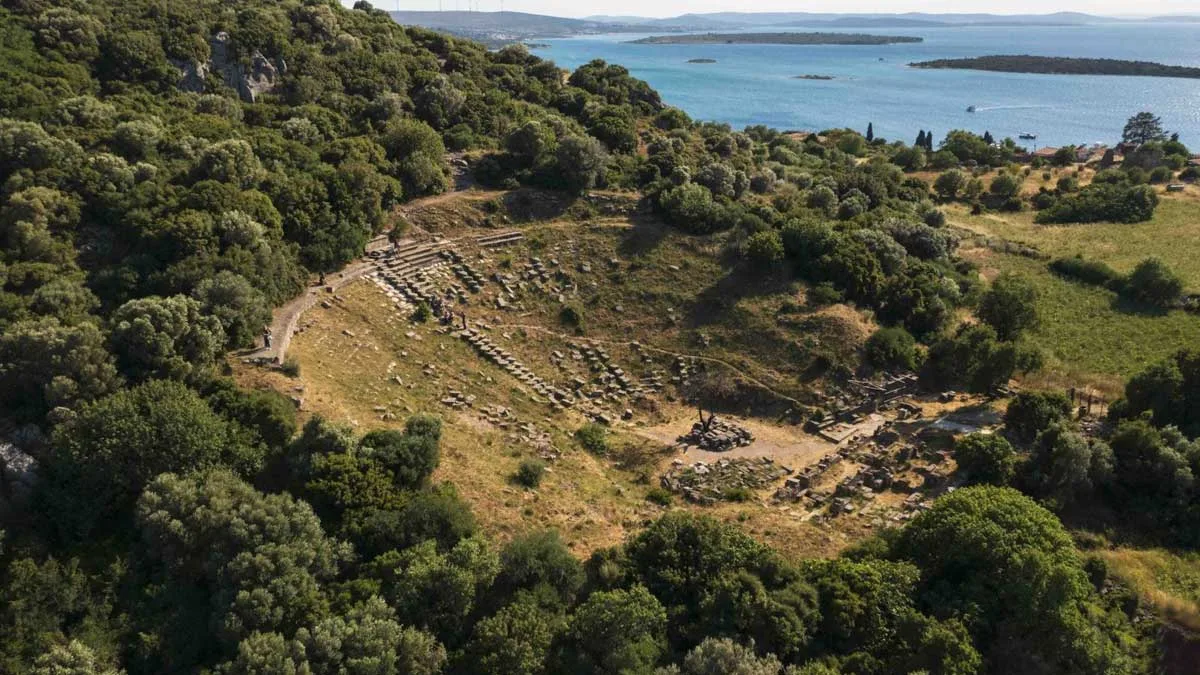
The ancient city of Erythrai is located in the Ildırı village of Çeşme on the Karaburun Peninsula in Izmir. It is thought that the word Erythrai is derived from the Greek "erythros" meaning "red", and that Erythrai was used in the sense of "Red City" due to the red color of the city's soil. According to another assumption, the city took its name from its first founder, Erythro, son of Cretan Rhadamanthes. Findings unearthed during the excavations carried out in the city show that there has been settlement in this region since the Early Bronze Age. During the Second Colonization Period, the city was under the rule of Knopos, who was a descendant of Kadros, King of Athens. Initially governed by a king, the city was later governed by vasileus, who were also of royal lineage but elected by the people. The city joined the Panionion religious and political union established among the Ionian cities; It experienced a short lived tyranny period with Paigagoras and gained importance with the millstones it produced and sold abroad during this period. Erythrai later fell into the hands of the Lydians and Persians. Like other Ionian cities, the city joined the revolt against the Persian yoke, and Alexander, along with all the other Ionian cities, gained independence in 334 BC. As a result of the turmoil that arose after Alexander's death, the city changed hands many times and fell into the hands of the Kingdom of Pergamon (Bergama). In 133 BC, it gained the status of a free city within the Roman Empire. During this period, it became famous for its wine, goats, millstones and the female prophetess Herophile, known as the Sibyl (Sibylla, the seer). The region, which suffered great destruction due to earthquakes, wars and the plundering of Roman commanders in the 1st century BC, lost its importance during the Byzantine period. After coming under Turkish rule in 1366, the region was given various names such as Erythre, Rhyrai, and Lythri; after the 16th century, it became known as İlderen and Ildırı. Excavations conducted by the Ankara University Department of Archaeology at the site unearthed the ancient theater on the northern slopes of the acropolis, thought to have been built in the late 3rd century BC. Only the foundations of the skene (stage) building, which featured a double diazoma (audience seating platforms), remain today. At the entrance to the theater is a monumental tomb, a heroon, built for an important person who lived in Erythrai. Excavations on the highest plain of the acropolis unearthed the remains of a temple of Athena. Based on the characteristics of its polygonal (polygonal) masonry, the temple was built in the second half of the 8th century BC and expanded with various additions in the following centuries. The masonry technique used and the ramp located in the interior are considered an important example of Archaic Age architecture. Excavations in the eastern part of the temple yielded pottery, stone, and clay figures dating from the 6th and 7th centuries BC. Terracotta goddess figurines predominate among these. Another important find near the temple, a rare example in the archaeological world, is a kore sculpture depicting a young woman/priestess in a long dress, dating back to the 6th century BC and currently in the Izmir Archaeological Museum. Excavations also revealed that the settlement was surrounded by a 5-kilometer long city wall. The first phases of the walls date back to the 4th century BC, the Late Classical period; however, the main sections were built during the Hellenistic period, in the 3rd-2nd centuries BC. The city walls, particularly those located parallel to the Ildırı Barbaros highway and reaching a height of five meters, have survived to the present day in a well preserved state. The first excavations at Erythrai were carried out between 1964 and 1982, and the second generation of excavations began in 2007.
Erythrai Ancient City
Ildır Köyü, Köyler, Çeşme, İzmir
Information
Category
Historical Places
Historical Places
Address
Köyler, Çeşme, İzmir
Köyler, Çeşme, İzmir
Views
1104
1104
Overview
Nearby Places
No nearby content yet.
Map
Ildır Köyü, Köyler, Çeşme, İzmir
Activities in the Area
No activities found in this area.
Events in the Area
No events found in this area.